SEARCH
A Safe Place to Explore
Questions About Life and God
Questions About Life and God
SEARCH
By Paul E. Little
It is impossible for us to know conclusively whether God exists and what he is like unless he takes the initiative and reveals himself.
We must scan the horizon of history to see if there is any clue to God's revelation. There is one clear clue. In an obscure village in Palestine, 2,000 years ago, a Child was born in a stable. Today the entire world is still celebrating the birth of Jesus, and for good reason. His life changed the course of history.
We're told that "the common people heard him gladly." And, "He taught as One who had authority, and not as their teachers of the Law."1
 It soon became apparent, however, that he was making shocking and startling statements about himself. He began to identify himself as far more than a remarkable teacher or prophet. He began to say clearly that he was Deity. He made his identity the focal point of his teaching.
The all-important question he put to those who followed him was, "Who do you say I am?" When Peter answered and said, "You are the Christ, the Son of the living God,"2 Jesus was not shocked, nor did he rebuke Peter. On the contrary, he commended him!
Jesus frequently referred to "My Father," and his hearers got the full impact of his words. We are told, "The Jews tried all the harder to kill him; not only was he breaking the Sabbath, but he was even calling God his own Father, making himself equal with God."3
On another occasion he said, "I and My Father are One." Immediately the religious authorities wanted to stone him. Jesus asked them which of his miracles caused them to want to kill him. They replied, "We are not stoning you for any of these but for blasphemy, because you, a mere man, claim to be God."4
Jesus clearly claimed powers which only God has.
One time Jesus said to a man who was paralyzed, "Son, your sins are forgiven you." The religious leaders immediately reacted. "Why does this fellow talk like that? He's blaspheming! Who can forgive sins but God alone?"
So Jesus said to them, “Which is easier: to say to this paralyzed man, ‘Your sins are forgiven,’ or to say ‘Get up and walk’?”
Jesus continued, “But that you might know that I have authority on earth to forgive sins, he said to the man, “Rise, pick up your bed and go home.” And the man was instantly healed to all of their amazement.
Jesus also made statements like this one: “I came that you might have life, and have it more abundantly.”5 And “I am the light of the world.”6
And he said numerous times that if anyone would believe in him, Jesus would give them eternal life. “He does not come into judgment, but has passed from death to life.”7 “I give them eternal life, and they shall never perish.”8
At the critical moment when Jesus’ life was at stake for making claims such as these, the high priest put the question to him directly: "Are you the Christ, the Son of the Blessed One?"
"I am," said Jesus. "And you will see the Son of Man sitting at the right hand of the Mighty One and coming on the clouds of heaven."
The high priest rendered the verdict. "Why do we need any more witnesses?" he asked. "You have heard his blasphemy."9
So close was Jesus' connection with God that he equated a person's attitude to himself with the person's attitude toward God. Thus, to know him was to know God.10 To see him was to see God.11 To believe in him was to believe in God.12 To receive him was to receive God.13 To hate him was to hate God.14 And to honor him was to honor God.15
The question is, was he telling the truth?
Maybe Jesus lied when he said he was God. Perhaps he knew he was not God, but deliberately deceived his hearers to give authority to his teaching. But there is a problem with this reasoning.
Even those who deny his deity will say that they think Jesus was a great moral teacher. They fail to realize that Jesus could hardly be a great moral teacher if, on the most crucial point of his teaching – his identity – he was a deliberate liar.
Another possibility is that Jesus was sincere but self-deceived. We have a name for a person today who thinks he is God. Mentally disabled.
But as we look at the life of Christ, we see no evidence of the abnormality and imbalance we find in a mentally ill person. Rather, we find the greatest composure under pressure.
A third alternative is that in the third and fourth centuries hisenthusiastic followers put words into his mouth he would have been shocked to hear. Were he to return, he would immediately repudiate them.
However, this also does not hold up. Modern archeology verifies that four biographies of Christ were written within the lifetime of people who saw, heard and followed Jesus. These gospel accounts (by Matthew, Mark, Luke and John) contained specific facts and descriptions confirmed by those who were eyewitnesses of Jesus.
Jesus was not a liar, or mentally disabled, or manufactured apart from historical reality. The only other alternative is that Jesus was being consciously truthful when he said he was God.
Anyone can make claims. There have been others who have claimed to be God. I could claim to be God, and you could claim to be God, but the question all of us must answer is, "What credentials do we bring to prove our claim?"
In my case, it wouldn't take you five minutes to debunk my claim. It probably wouldn't take too much more to dispose of yours.
But when it comes to Jesus of Nazareth, it's not so simple. He had the credentials to back up his claim. He said, "Even though you do not believe me, believe the evidence of the miracles, that you may learn and understand that the Father is in Me, and I am in the Father."16
 Jesus' moral character aligned with his claims. The quality of his life was such that he was able to challenge his enemies with the question, "Can any of you prove me guilty of sin?"17 His enemies could offer no response. They were silent.
We read of Jesus being tempted by Satan, but we never hear of a confession of sin on his part. He never asked for forgiveness, though he told his followers to do so.
This lack of any sense of moral failure on Jesus' part is astonishing since it is completely contrary to the experience of the saints and mystics throughout the ages. The closer men and women draw to God, the more overwhelmed they are with their own failure, corruption, and shortcomings. The closer one is to a shining light, the more he realizes his need for a bath.
It is also striking that John, Paul, and Peter, all of whom were trained from earliest childhood to believe in the universality of sin, all spoke of the sinlessness of Christ: "He committed no sin, and no deceit was found in his mouth."18
Even Pilate, who sentenced Jesus to death, asked, "What evil has he done?" After listening to the crowd, Pilate concluded, "I am innocent of this man's blood; see to it yourselves." The crowd relentlessly demanded Jesus be crucified (for blasphemy, claiming to be God). The Roman centurion who assisted in the crucifixion of Christ said, "Surely he was the Son of God."19
Jesus constantly demonstrated both his power and compassion. He made the lame to walk, the blind to see, and healed those with diseases.
For example, a man who had been blind from birth was known by everyone as the familiar beggar who sat outside the temple. After Jesus healed him, the religious authorities interrogated the beggar about Jesus.
The man replied, "One thing I do know. I was blind but now I see!" He couldn’t understand how these religious authorities didn't recognize this Healer as the Son of God. "Nobody has ever heard of opening the eyes of a man born blind," he said.20 To him the evidence was obvious.
Jesus also demonstrated a supernatural power over nature itself. He commanded a raging storm of high wind and waves on the Sea of Galilee to be calm. Those in the boat were awestruck, asking, "Who is this? Even the wind and waves obey him!"21
He turned water into wine, at a wedding. He fed a massive crowd of 5,000 people, starting with five loaves of bread and two fish. He gave a grieving widow back her only son by raising him from the dead.
Lazarus, a friend of Jesus' died and had been buried in a tomb for four days already. Yet Jesus said, "Lazarus, come forth!" and dramatically raised him from the dead, witnessed by many.
It is most significant that his enemies did not deny this miracle. Rather, they decided to kill Jesus. "If we let him go on like this," they said, "everyone will believe in him."22
Several times, Jesus clearly stated how he would die. He said that he would be arrested, tortured and die by crucifixion, with his body nailed to a cross until death.
He explained that by freely laying down his life, he would pay for the sins of all humankind so that we might be forgiven. And he said that three days after his burial, he would physically come back to life again.
The events that transpired fulfilled that.
The religious authorities arrested him for blasphemy, for claiming to be equal to God (which he clearly said).
He was brought before the Roman government and sentenced to death by crucifixion.
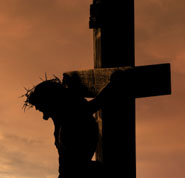
 Jesus was more than 40 times lashed with a multi-cord whip having metal or bone fragmented ends. A mock crown of long thorns was beaten into his skull. Then they nailed his feet and wrists to a wooden cross, erected it, and Jesus hung there, eventually dying. A sword was thrust into his side to confirm his death.
The body of Jesus was taken from the cross, wrapped in mummy-like linens covered with gummy-wet spices. His body was placed in a solid rock tomb, where a very large boulder was rolled down to it, to secure the entrance.
Everyone knew that Jesus said he would rise from the dead in three days. The Roman Government also affixed an official Roman seal to the outside of the tomb declaring it government property and stationed an entire guard of trained Roman soldiers at the entrance of the tomb.
Despite all this, three days later the boulder formerly sealing the tomb was found up a slope, some distance away from the tomb. The body was gone. Only the grave linens were found in the tomb, empty of the body.
It is important to note that both critics and followers of Jesus agree that the tomb was empty and the body missing.
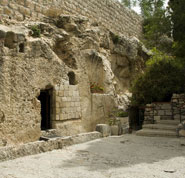 However, it wasn't the empty tomb that convinced Jesus' followers of his deity.
That alone did not convince them that Jesus actually rose from the dead, was alive, and was God. What convinced them were the number of times that Jesus showed up, in person, in the flesh, and ate with them, and talked with them. Different locations, different times, to a variety of different people.
Luke, one of the gospel writers, says of Jesus, "he presented himself to them and gave many convincing proofs that he was alive. He appeared to them over a period of forty days and spoke about the kingdom of God."23
All four of the gospel writers give accounts of Jesus physically being alive again.
On one occasion when Jesus joined the disciples, Thomas was not there. When they told Thomas about it, he simply wouldn't believe it. He flatly stated, "Unless I see the nail marks in his hands and put my finger where the nails were, and put my hand into his side, I will not believe it."
One week later, Jesus came to them again with Thomas now present. Jesus said to Thomas, "Put your finger here; see my hands. Reach out your hand and put it into my side. Stop doubting and believe." Thomas replied, "My Lord and my God!"
Jesus told him "Because you have seen me, you have believed; blessed are those who have not seen and yet have believed."24
Christ gives purpose and direction to life. “I am the light of the world,” he says. “Whoever follows me will never walk in darkness, but will have the light of life.”25
The late Carl Gustav Jung said, “The central neurosis of our time is emptiness.” We think that experiences, relationships, money, success, fame will finally provide the happiness we seek. But there is always a gap left. They don’t fully satisfy. We have been made for God and find fulfillment only in him.
Jesus said, “I am the bread of life. Whoever comes to me shall not hunger, and whoever believes in me shall never thirst.”26
 You can begin an intimate relationship with him right now. You can begin to personally know God in this life on earth, and after death into eternity. Here is God's promise to us:
"For God so loved the world, that he gave his only Son, that whoever believes in him should not perish but have eternal life."27
Jesus took our sin on himself, on the cross. He chose to receive punishment for our sin, so that our sin would no longer be a barrier between us and him. Because he fully paid for your sin, he offers you complete forgiveness and a relationship with him.
Here is how you can begin that relationship.
Jesus said, "Behold, I stand at the door [of your heart] and knock; if anyone hears my voice and opens the door, I will come into him."28
Right now you can invite Jesus Christ into your life. The words are not important. What matters is that you respond to him, in light of what he has done for you, and is now offering you. You could say to him something like, "Jesus, I believe in you. Thank you for dying on the cross for my sins. I ask you to forgive me and to come into my life right now. I want to know you and follow you. Thank you for coming into my life and giving me a relationship with you, right now. Thank you."
If you asked Jesus into your life, we would like to help you grow to know him better. In whatever way we can help you, please feel free to click on one of the links below.
| ► | I just asked Jesus into my life (some helpful information follows)... |
| ► | I may want to ask Jesus into my life, please explain this more fully... |
| ► | I have a question or comment... |
Footnotes: (1) Matthew 7:29 (2) Matthew 16:15-16 (3) John 5:18 (4) John 10:33 (5) John 10:10 (6) John 8:12 (7) John 5:24 (8) John 10:28 (9) Mark 14:61-64 (10) John 8:19; 14:7 (11) 12:45; 14:9 (12) 12:44; 14:1 (13) Mark 9:37 (14) John 15:23 (15) John 5:23 (16) John 10:38 (17) John 8:46 (18) 1 Peter 2:22 (19) Matthew 27:54 (20) John 9:25, 32 (21) Mark 4:41 (22) John 11:48 (23) Acts 1:3 (24) John 20:24-29 (25) John 8:12 (26) John 6:35 (27) John 3:16 (28) Revelation 3:20
Adapted from Know Why You Believe by Paul E. Little, published by Victor Books, copyright (c) 1988, SP Publications, Inc., Wheaton, IL 60187. Used by permission.
About the Author: Paul E. Little was an author and speaker who served with InterVarsity Christian Fellowship and wrote several books, including Know Why You Believe. His work has helped many people explore the intellectual and personal basis for believing in God.


Other articles/videos you might be interested in…